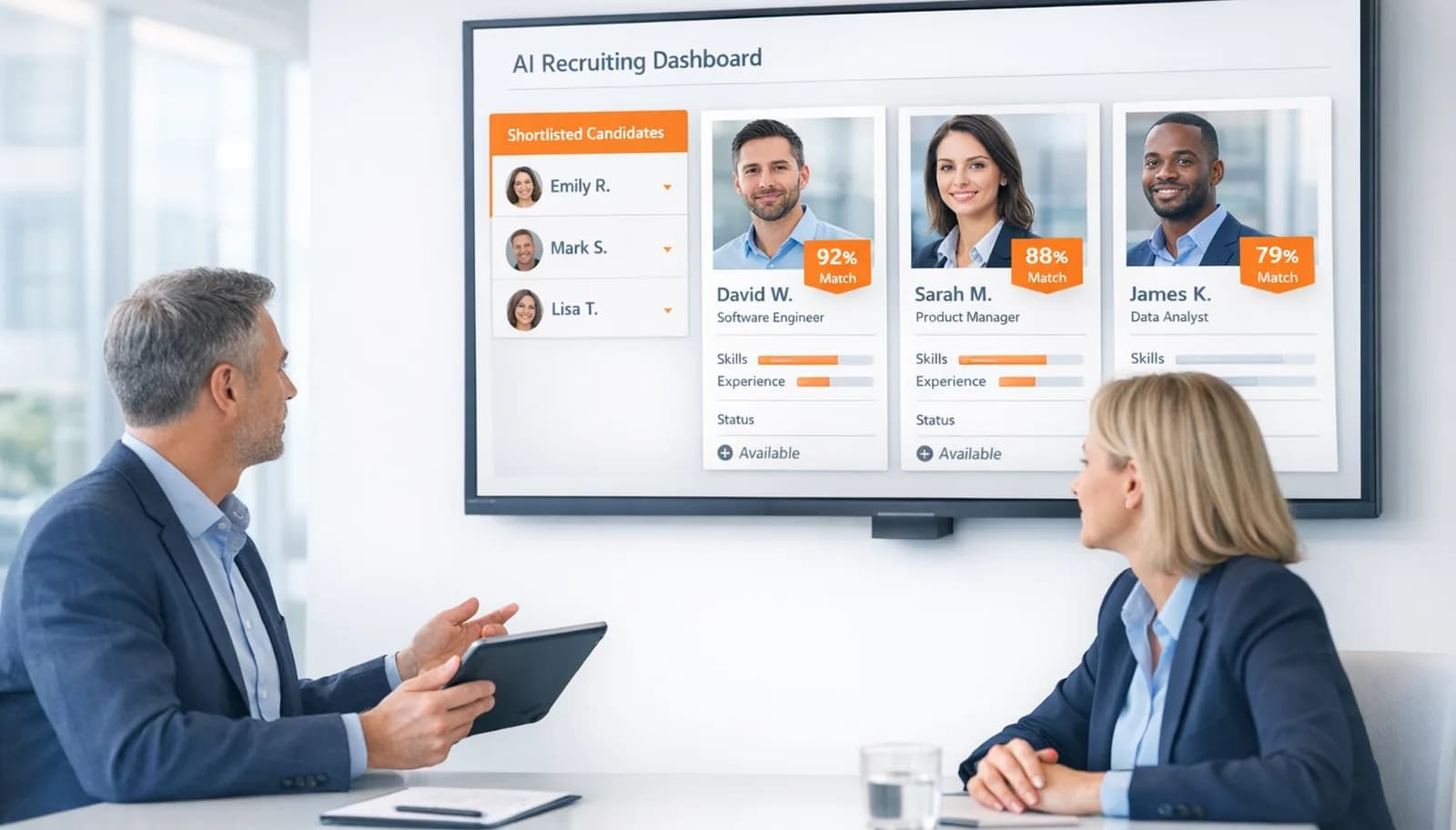
AI Recruiting Software: Should You Buy a Platform or Build Your Own?
Every recruiting tool now says it's AI powered. Here's a fair look at when buying a platform is the smarter move, and when a custom AI recruiting agent built around your own criteria and systems makes more sense.
Almost every recruiting tool now markets itself as AI recruiting software. Some of them are great. Some are a keyword filter with a chat window on top. For a growing company, the bigger question is whether to buy a platform at all, or build an AI recruiting agent that works the way your team already hires.
This guide gives you a fair look at both paths. We build custom software, so we have a point of view. But we'll also tell you plainly when buying is the smarter move, because often it is.
What Counts as AI Recruiting Software Today
"AI recruiting software" covers a wide range of products. Most fall into one of four groups:
- ATS with AI matching: An applicant tracking system that scores or ranks applicants against a job description.
- Resume screening tools: Standalone tools that parse resumes, pull out skills and experience, and sort candidates into tiers.
- AI sourcing tools: Tools that search candidate databases and public profiles to find people who fit a role, then help you reach out.
- AI recruiting assistants: Chat based helpers that answer candidate questions, ask screening questions, and book interviews.
When a product says "AI powered," it usually means three things: matching candidates to roles, ranking them by fit, and running screening conversations over chat or text. That's useful. But it helps to know that the matching logic is built for the average customer, not for your company.
What Off-the-Shelf AI Recruiting Platforms Do Well
Established platforms like Bullhorn, Loxo, and Crelate are widely used by recruiting teams and staffing firms, and for good reason. Buying a mature platform gets you a lot on day one:
- Fast setup: You sign up, import your data, and start working. There's no build phase.
- A built-in candidate database and sourcing: Many platforms come with sourcing features or a candidate database, so your team isn't starting from an empty list.
- Proven matching models: Vendors tune their matching across many customers and roles. For common roles, that's a real advantage.
- Lower upfront cost: You pay a subscription instead of funding a build. That's easier on cash flow when you're starting out.
- Support and updates handled for you: The vendor fixes bugs, ships new features, and keeps the lights on. You don't need anyone in house to maintain it.
If your needs match what the platform was designed for, this is a strong deal. You get years of product work for the price of a subscription.
Where Off-the-Shelf Tools Fall Short for Growing Businesses
The trade-offs show up as you grow, hire more, or hire for harder roles.
Generic Scoring
A platform's match score reflects what its model thinks a good candidate looks like. Your hiring managers may care about very different things. Maybe you value a specific certification, a type of customer experience, or a career path that doesn't look standard on paper. If the scoring can't reflect that, recruiters end up re-screening by hand, and qualified people with unusual resumes get missed.
Per-Seat Pricing That Grows With Your Team
Most recruiting platforms charge per user. That's fine for a small team. As you add recruiters, coordinators, and hiring managers who need access, the bill grows with every seat, whether or not each person uses the tool much.
Limited Connections to Your Other Systems
Hiring rarely lives in one tool. You might have an ATS, an HRIS, a calendar system, a background check provider, and a few spreadsheets. Platforms offer integrations, but they cover the common cases. If your workflow depends on a custom step or an internal system, you often end up copying data by hand between tools.
Less Control Over Candidate Data
With a hosted platform, candidate data lives on the vendor's infrastructure under the vendor's terms. For many companies that's acceptable. For others, especially those with strict client contracts or internal data policies, it's a real concern. You also have limited say in how the AI makes its decisions, which matters when you need to explain why a candidate was ranked low.
When Buying an AI Recruiting Platform Is the Right Call
Let's be direct: for a lot of companies, buying is the better choice. It probably makes sense if:
- You hire a handful of people a year, not dozens a month.
- Your roles are standard, like sales reps, support staff, or general office roles.
- You don't have an internal hiring workflow that's worth protecting or that gives you an edge.
- You need something working right away and can't wait for a build.
- You don't have other systems that the recruiting tool must talk to.
If that sounds like you, buy a platform. For early-stage companies and low-volume hiring, a good off-the-shelf tool is almost always the smarter move. A custom build would cost more than the problem is worth. You can always revisit the decision once hiring volume or complexity grows.
When Building a Custom AI Recruiting Agent Makes More Sense
A custom recruitment AI agent starts to pay off when hiring is central to how your business runs. Look at building if:
- You hire at high volume or for specialized roles: Screening hundreds of applicants a week, or roles where generic matching misses the point, is where custom logic earns its keep.
- You score against internal rubrics: If your team already has a clear scorecard for each role, an agent can apply it the same way every time.
- You work across several systems: An agent can read from your ATS, write to your HRIS, and book time on your calendar in one flow, with no copy and paste between tools.
- You want screening logic that reflects your own criteria: You decide what counts, how much it counts, and how the agent explains its ranking.
- Candidate data must stay inside your infrastructure: A custom build can run in your own cloud account, under your own security and retention rules.
For a real example, see how we built an intelligent recruitment platform for an HR tech company. Recruiters there were buried in resumes and passing over qualified candidates whose resumes didn't match the job description word for word. We worked with the client's talent team to design evaluation rubrics based on role competencies. Then we built AI resume parsing and ranking, automated voice interviews, a co-pilot that helps human interviewers score responses in real time, and two-way sync with Greenhouse and Workday. Most companies need far less than that. The example shows how a custom build can fit the exact systems and criteria a team already uses.
This kind of work falls under AI agent development: software that takes multi-step actions across your tools, with humans making the final calls.
How to Use AI in Recruiting Without a Platform
You don't need to buy an all-in-one platform to use AI in hiring. You can add AI to the steps that eat the most recruiter time, one at a time:
- Resume screening agents: An agent reads each resume, pulls out skills and experience, compares them to your rubric, and writes a short summary of why the candidate fits or doesn't.
- Automated candidate outreach: The agent drafts personal messages to shortlisted candidates, sends follow-ups, and logs replies back to your ATS.
- Interview scheduling agents: The agent checks interviewer calendars, offers open slots to the candidate, books the meeting, and sends reminders.
- AI-generated structured scorecards: After an interview, the agent turns notes or a transcript into a scorecard against your criteria, so every candidate is judged on the same points.
Each of these works on its own. If you hire at volume, you can go further and connect them end to end: a new application arrives, gets screened against your rubric, the best candidates get an outreach message, interviews get booked, and scorecards land in your ATS. Your recruiters review and decide. The agent handles the busywork in between.
Build vs Buy: A Quick Decision Checklist
Compare your situation on these five points. If most of your answers land in the "buy" column, buy. If most land in the "build" column, it's worth scoping a custom agent.
| Factor | Lean Buy | Lean Build |
|---|---|---|
| Hiring volume | Low or occasional | High and steady, or growing fast |
| Systems to connect | One tool, or common integrations only | ATS plus HRIS plus calendar plus internal tools |
| Screening criteria | Standard roles, generic fit is fine | Specific rubrics that generic scoring can't match |
| Budget horizon | You want low upfront spend now | You'd rather own the tool than pay per seat as you grow |
| Data control | Vendor hosting is acceptable | Candidate data must stay in your own infrastructure |
Your next step:
- Mostly buy: Shortlist two or three platforms, run a trial with a real open role, and pick the one your recruiters like using.
- Mixed: Buy a platform for the core, then add a custom agent for the one step that hurts most, like screening or scheduling.
- Mostly build: Write down your current hiring workflow and scorecards, then scope a custom agent around them. See our recruitment AI agent for what that can include.
Not sure which way to go? Book a free consultation and we'll map it with you.
Frequently Asked Questions
What is the best AI tool for recruiters?
There isn't one best tool for everyone. For small teams hiring for standard roles, an established platform such as Bullhorn, Loxo, or Crelate is a sensible place to start. Trial a few with a real open role. For high-volume or specialized hiring, the best tool is often one built around your own criteria and systems.
How can you use AI in recruiting?
The most common uses are resume screening, candidate outreach, interview scheduling, and structured interview scorecards. Start with the step that takes your team the most time, and keep a human in charge of hiring decisions. Check your screening for bias and follow local rules on automated hiring tools.
Who has the best AI agent for recruitment?
It depends on what the agent needs to do. Platform vendors offer agents that work well inside their own product. If you need an agent that follows your rubrics and works across your ATS, HRIS, and calendar, a custom build is usually the better fit.
Do recruiters care if you use AI for a resume?
In general, recruiters care more about accuracy and clarity than about how the resume was written. Using AI to tighten wording is generally fine. Problems start when a resume looks generic or claims skills the candidate can't back up in an interview.
How much does a custom AI recruiting agent cost?
The main cost drivers are how many steps the agent automates, how many systems it connects to, how complex your screening rubrics are, and where it needs to be hosted. We set pricing during scoping, once we understand your workflow. See our pricing page for how engagements work.
How long does it take to build one?
It depends on scope. A single-step agent, like resume screening, is a smaller project than an end-to-end agent tied into several systems. Most builds move through the same phases: rubric design, core agent logic, integrations, and testing with real candidates. We agree on the timeline during scoping. Details are on our pricing page.
Not Sure Which Way to Go?
If you're weighing a platform against a custom build and want a second opinion, talk to an AI consultant. We'll look at your hiring volume, your systems, and your screening criteria, and tell you honestly whether buying or building makes more sense.